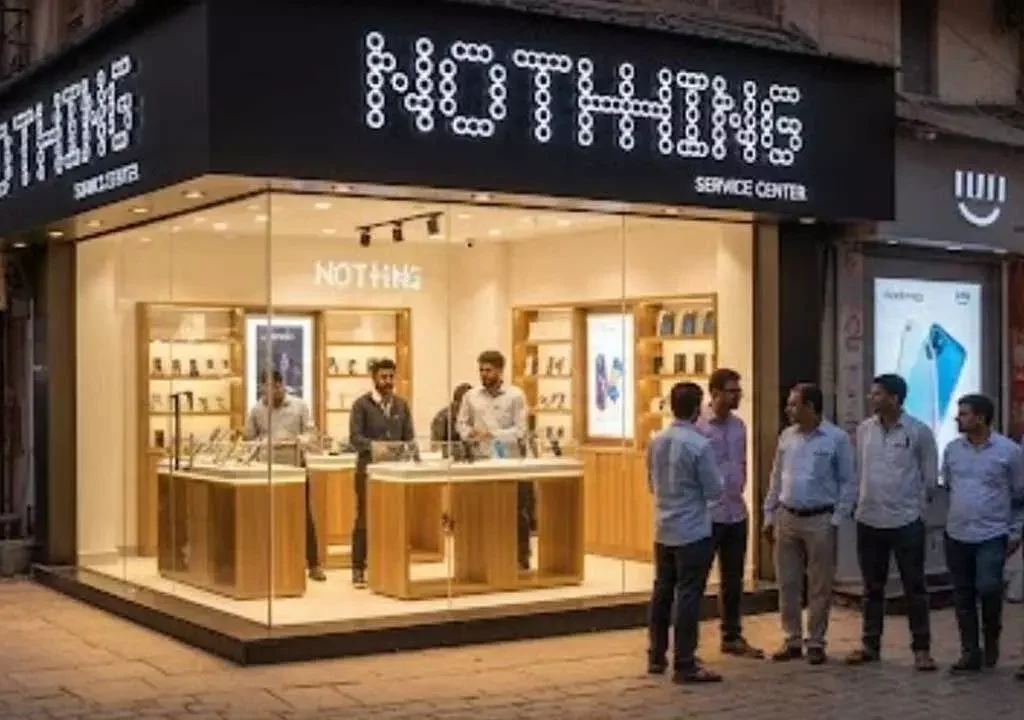

Nothing opens offline stores in India with first flagship outlet in Bengaluru

Nothing opens offline stores in India

Nothing opens offline stores in India with the announcement of its first flagship retail outlet in Bengaluru, signalling a strategic move beyond online sales and short-term pop-up events. The decision highlights India’s growing importance in Nothing’s global expansion plans.

The announcement was teased through a series of social media posts, including a visual featuring Nothing’s signature dragonfly travelling from London to Bengaluru. The imagery links the company’s UK origins with its next phase of growth in India, using transparent display boxes showcasing London landmarks and Bengaluru’s Vidhana Soudha.

So far, Nothing’s presence in India has been driven primarily through e-commerce platforms and limited pop-up experiences. The upcoming flagship store will be the company’s first permanent, standalone retail space in the country, designed to offer customers a more immersive way to experience its products.

According to the company, the store will allow visitors to interact with Nothing’s smartphones and audio devices in a relaxed, exploratory setting. Customers will be able to see the brand’s transparent design philosophy up close, try features such as the Glyph Interface, and better judge build quality and usability before making a purchase.

This move addresses a key gap in Nothing’s India strategy. While the brand has built strong awareness among younger, online-first buyers, offline visibility remains crucial for higher-priced devices. A physical store offers reassurance to first-time buyers who prefer hands-on experience before committing.

Nothing opens offline stores
Nothing against rivals

The flagship store also places Nothing closer to established rivals such as Apple, Samsung, and Xiaomi, all of which already operate extensive offline retail networks in India. Having a dedicated retail space gives Nothing a fixed venue for product launches, walk-in discovery, and direct customer interaction instead of relying solely on third-party retailers.

The retail push comes alongside broader efforts to deepen the company’s roots in India. Nothing’s sub-brand CMF has been registered locally as CMF India Private Limited, with the company confirming that full smartphone manufacturing operations for CMF will move to India. The local entity will oversee manufacturing, operations, and research and development for CMF products.

Nothing has confirmed the Bengaluru location via posts on X and Instagram, though the exact opening date has not yet been revealed. The company has indicated that further details will be shared closer to launch.

Nothing’s first physical store opened in London’s Soho district in 2022. The upcoming Bengaluru flagship will be its first such outlet outside the UK, reinforcing India’s role as a long-term focus market for the brand.

Apple Overtakes Samsung to Become the World’s Top Smartphone Company in 2025

apple overtakes samsung

Apple overtakes Samsung to become the world’s top smartphone company in 2025, marking a major shift in global shipment leadership after more than a decade.

According to the latest data from Counterpoint Research, global smartphone shipments grew by 2% year-on-year in 2025, reaching around 1.26 billion units. While the overall market growth remained modest, Apple emerged as the biggest winner, driven by strong demand for its latest iPhones and a growing preference for premium devices.

Apple captured roughly 20% of global smartphone shipments, narrowly edging out Samsung, which slipped to second place with around 18–19% market share depending on the research firm. Xiaomi retained its third position with a 13% share, followed by Vivo and Oppo in the mid-single digits.

iPhone 17 Drives Apple’s Rise

Apple’s shipments grew by an impressive 10% compared to 2024, a standout performance in an otherwise slow-moving market. Analysts attribute this growth primarily to strong sales of the iPhone 17 series, along with sustained demand for the iPhone 16 lineup in key regions such as India, Japan, and Southeast Asia.

Unlike most Android manufacturers, Apple continues to focus on a limited number of models while maximising average selling prices. This strategy paid off in 2025, as consumers increasingly opted for longer-lasting, premium smartphones instead of frequent upgrades.

The fourth quarter proved decisive. Holiday demand and improved inventory management helped Apple dominate year-end shipments, allowing it to pull ahead of Samsung and secure the top position for the year.

Samsung Faces Regional Pressure Despite Solid Lineup

Samsung’s fall to second place does not reflect weak products. The company recorded shipment growth of around 5% year-on-year, supported by strong performance from the Galaxy A series, as well as traction from the Galaxy S25 and Galaxy Z Fold 7 in the premium segment.

However, Samsung faced pressure in regions such as Latin America and Western Europe, where competition intensified and demand softened. While it saw growth in Japan and maintained strength in its core markets, the gains were not enough to offset Apple’s premium-led surge.

Samsung’s broader product portfolio, once its biggest advantage, has become harder to defend in a market where consumers are prioritising quality, ecosystem integration, and long-term software support over sheer variety.

Premiumisation Shapes the Market

One of the clearest trends in 2025 was the continued premiumisation of smartphones. Buyers increasingly favoured high-end devices with better cameras, longer software support, and AI-driven features.

Apple benefited the most from this shift, thanks to its ecosystem lock-in and tight control over hardware and software. Its vertically integrated supply chain also helped it navigate component cost pressures more effectively than many rivals.

Samsung remains competitive through innovation, particularly in foldables and display technology, but faces tougher competition in the mid-range from Chinese brands like Xiaomi, Vivo, and Oppo.

A Tight Race, But a Symbolic Shift

It is worth noting that shipment rankings vary slightly between research firms such as Counterpoint, IDC, and Omdia. However, the broader conclusion remains consistent: Apple and Samsung are extremely close, and leadership can shift from quarter to quarter.

Even so, Apple finishing 2025 at the top is symbolically important. It highlights a deeper change in consumer behaviour, where premium experiences and ecosystem value increasingly outweigh sheer volume.

As the industry heads into 2026, competition between Apple and Samsung is expected to intensify further, especially around AI features, on-device processing, and next-generation hardware. For consumers, that rivalry is likely to translate into faster innovation and better smartphones across the board.